Scopes
Overview
Scope determines where a variable or object can be accessed in a program. Python has three main types of scope:
-
Global scope
- Names defined in the main body of a script
- Accessible anywhere in the script unless shadowed by a local name
-
Local scope
- Names defined inside a function
- Only exist while the function is running
- Cannot be accessed outside the function
-
Built-in scope
- Names provided by Python itself, such as
print()orsum() - Always available unless overridden by local or global names
- Names provided by Python itself, such as
LEGB Rule
Python uses a set of rules called LEGB to figure out which variable you mean.
Local ➔ Enclosing ➔ Global ➔ Built-in.
How it works:
- Python looks for variables first in the local scope
- Then it checks the enclosing or nonlocal scope for nested functions
- Next it searches the global scope
- Finally it looks in the built-in scope
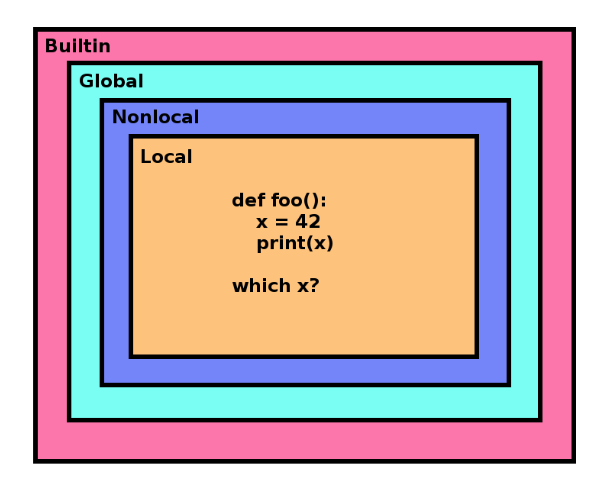
In the example below, the interpreter finds the x in the local scope first:
x = 7

def foo():
    x = 42
    print(x)

foo()
print(x)
Output:
42
7
Local Variables
Variables defined inside a function are local and cannot be accessed outside.
def square(x):
    new_val = x ** 2
    return new_val

square(4)

print(new_val)  # Error: new_val is not defined
Here, new_val exists only inside the function and is gone after the function ends.
Global Variables
Functions can access global variables, which are declared outside any function. If a local variable has the same name, it takes priority over the global one.
In this example, the multiply function uses the global multiplier because no local variable named multiplier is defined.
multiplier = 5      # Global

def multiply(x):
    return x * multiplier

print(multiply(3))  # Output: 15
print(multiplier)   # Output: 5
In this second example, the local multiplier inside the function takes precedence. The global multiplier is unchanged.
multiplier = 5          # Global

def multiply_local(x):
    multiplier = 2      # Local
    return x * multiplier

print(multiply_local(3))  # Output: 6
print(multiplier)         # Output: 5
Global Variable Updates
A function sees the current value of a global variable when it is called.
Here, the global new_val is initially assigned 5, so square(3) returns 14. After updating new_val to 10, the same function call returns 19.
new_val = 5

def square(x):
    return x ** 2 + new_val

print(square(3))  # Output: 14

new_val = 10
print(square(3))  # Output: 19
Modifying Global Variables
Normally, a function cannot change a global variable unless you explicitly tell Python to do so. You use the global keyword to allow a function to modify a global variable.
In this example, the square_global updates the global new_val directly because of the global keyword.
new_val = 4

def square_global():
    global new_val
    new_val = new_val ** 2

square_global()
print(new_val)  # Output: 16
You can also see how global works when changing a variable inside a function while printing it:
value = 10

def example_global():
    global value
    value = 5
    print("Inside function:", value)

example_global()
print("Outside function:", value)
Output:
Inside function: 5
Outside function: 5
Using nonlocal in Nested Functions
Nested functions can modify variables in their parent function using the nonlocal keyword:
def outer():
    y = 10
    def inner():
        nonlocal y
        y = 20
    inner()
    print(y)

outer()
Output:
20
Note: For advanced usage in nested functions and closures, see Nested Functions