Well-Architected Framework
Overview
The Google Cloud Well-Architected Framework is a practical blueprint for cloud design.
It helps you evaluate architectural choices using six pillars, and it is especially useful for the Professional Cloud Architect (PCA) exam.
Instead of treating this as a memorization topic, use it as a decision lens for every design choice.
The Six Pillars
A well-architected solution balances all six pillars, and it does not optimize one pillar in isolation.
| Pillar | Core Question | Typical Design Focus |
|---|---|---|
| Operational Excellence | Can the team deploy, operate, and improve this safely over time? | CI/CD, infrastructure as code, observability, and incident response |
| Security, Privacy, and Compliance | Is data protected, and are controls aligned with regulation? | IAM, encryption, network controls, and policy enforcement |
| Reliability | Can the system continue when components or regions fail? | Redundancy, failover, health checks, and recovery planning |
| Performance Optimization | Does the system perform well for current and future demand? | Right compute choices, caching, scaling, and architecture patterns |
| Cost Optimization | Is spend aligned with business value and usage patterns? | Rightsizing, autoscaling, and committed-use strategy |
| Sustainability | Does the design reduce unnecessary environmental impact? | Efficient managed services, low waste, and region strategy |
Importance for PCA Exam
PCA scenarios usually test trade-offs, and not isolated best practices.
Examples:
- Multi-region design improves reliability, and it can increase cost.
- Customer-managed keys can improve control, and they add operational complexity.
- Oversized compute can improve raw performance, and it can reduce cost efficiency.
The best exam answer is usually the design that meets the business objective with the best balance across pillars.
When two options are both technically valid, choose the one that better matches constraints such as compliance, recovery objectives, cost limits, and operational maturity.
Operational Excellence
Operational excellence is the ability to deploy, monitor, and recover efficiently.
A practical pattern on Google Cloud is:
- Push code to source control.
- Run automated build and tests with Cloud Build.
- Store artifacts in Artifact Registry.
- Roll out progressively with Cloud Deploy to Cloud Run or GKE.
- Monitor and investigate with Cloud Monitoring, Cloud Logging, and traces.
- Roll back quickly when health checks fail.
This approach reduces manual work, and it improves consistency, response speed, and team confidence.
Note: Manual deployment steps increase risk during incidents, because they are slower and more error-prone.

Security, Privacy, and Compliance
This pillar protects systems and data from threats, and it also ensures privacy and regulatory alignment.
Design for security from day one, and not at the final review stage.
- Enforce Least privilege with IAM roles and service accounts.
- Protect Data with encryption at rest and in transit, and use Cloud KMS when stronger key control is required.
- Restrict Network paths with VPC controls and firewall policies.
- Audit Access and changes with centralized logging and security monitoring.
In PCA scenarios with regulated workloads, the expected design usually combines identity controls, network controls, encryption, and auditability.
Note: Security, privacy, and compliance are linked, and a gap in one area often creates risk in the others.

Reliability
Reliability is the ability to keep services available, and to recover quickly when failures occur.
Failures are inevitable, so architecture should prevent local issues from becoming full outages.
| Term | Description | Example |
|---|---|---|
| SLI (Service Level Indicator) | The measured metric, such as successful requests under a latency threshold. | 99.8% of requests complete in under 200 ms. |
| SLO (Service Level Objective) | The internal target for the SLI metric. | Target: 99.9% of requests should complete in under 200 ms each month. |
| SLA (Service Level Agreement) | The external commitment to customers, typically with business or financial consequences if not met. | Customers are guaranteed 99.9% uptime, or they receive service credits. |
Set the SLO stricter than the SLA so the team has recovery buffer before customer commitments are breached.
For disaster recovery targets, use these terms:
| Term | Description | Example |
|---|---|---|
| RTO (Recovery Time Objective) | Maximum acceptable downtime after an incident before service must be restored. | Restore the service within 2 hours after an outage. |
| RPO (Recovery Point Objective) | Maximum acceptable data loss measured as time between the last good state and failure. | Lose at most 15 minutes of data after a failure. |
Lower RTO and lower RPO require stronger and usually more expensive architectures, such as multi-region failover and more frequent or synchronous replication.
- Deploy Across zones to remove single points of failure.
- Use Multi-region patterns when recovery objectives require stronger resilience.
- Automate Healing with health checks and managed failover.
Right-size the recovery model to business requirements, because over-engineering can be as costly as under-engineering.

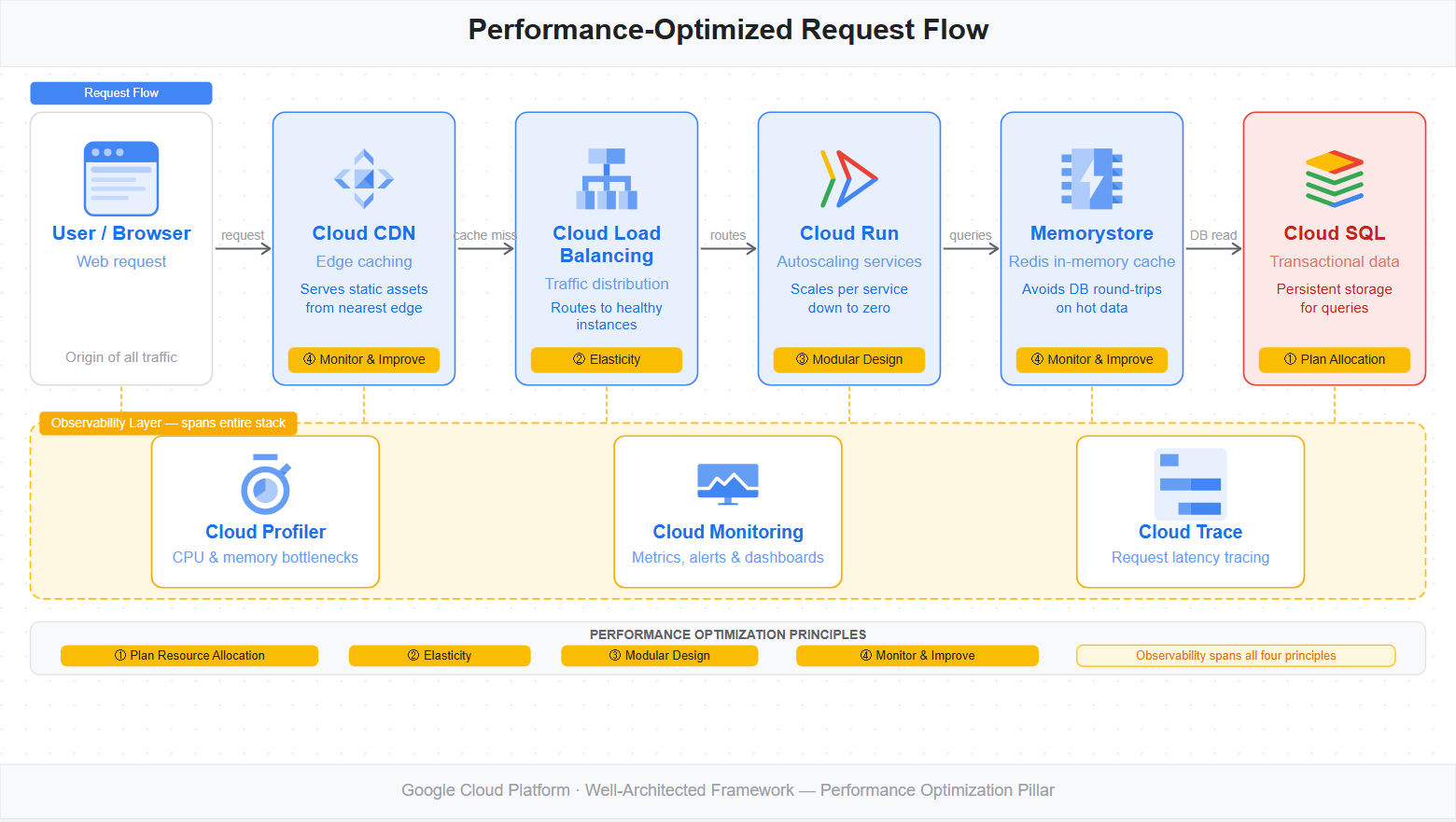
Performance Optimization
Performance optimization is about delivering the right performance for user needs, consistently and efficiently.
It is not about maximum speed everywhere, because performance must be balanced with cost and operational complexity.
- Measure First with load testing, profiling, and tracing.
- Scale Elastically with managed instance groups, GKE autoscaling, or Cloud Run.
- Design Modular services so bottlenecks can be tuned independently.
- Improve Continuously by monitoring latency, throughput, and saturation over time.
Caching and load balancing are core design tools, because they reduce backend pressure and improve response time under load.
Cost Optimization
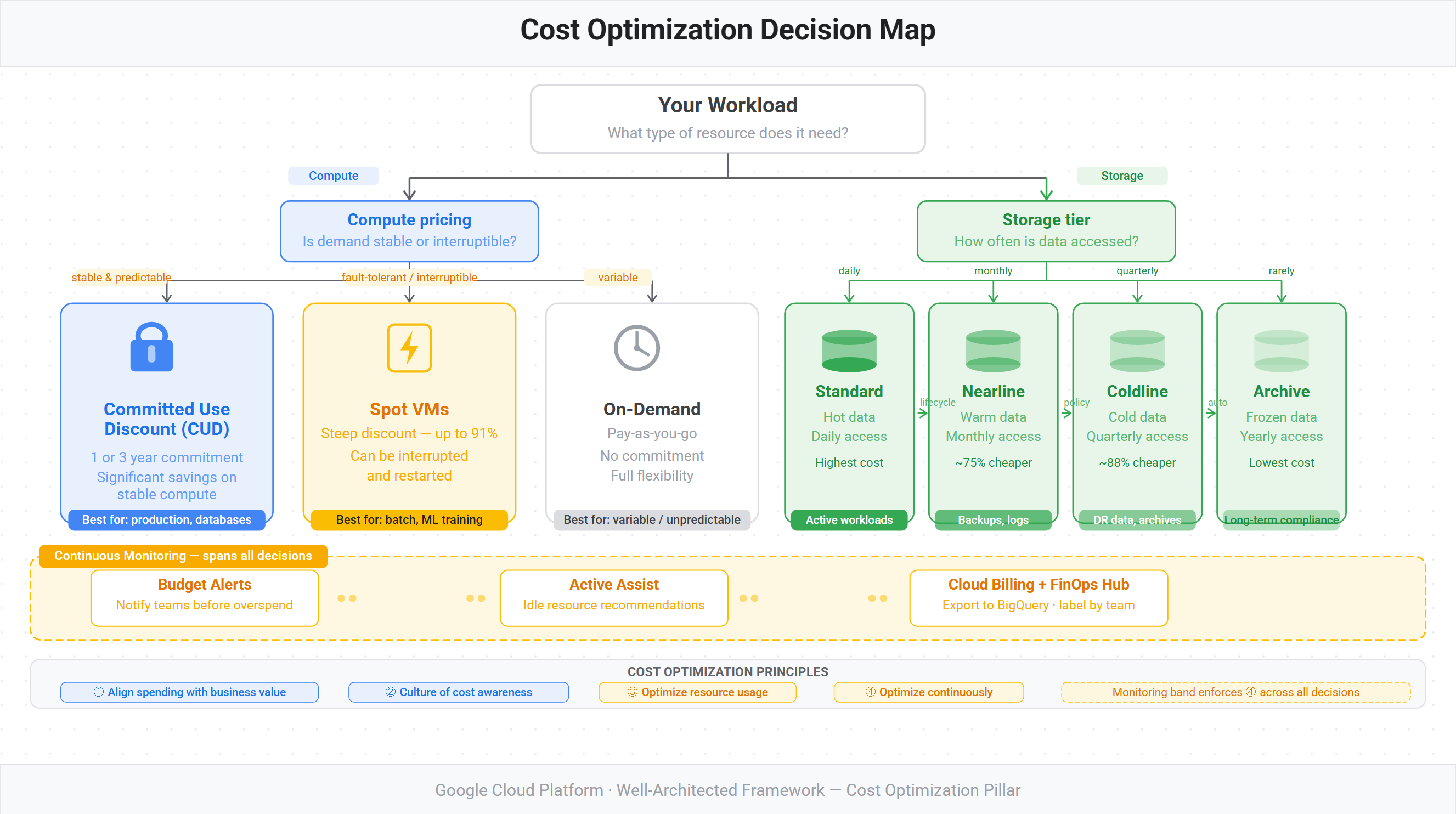
Cost optimization means maximizing business value from cloud spend, and not simply minimizing the invoice.
The most effective decisions align resource spend with workload criticality and usage patterns.
- Match Investment to business value for each environment and service.
- Increase Visibility with budgets, alerts, and labels by team, app, and environment.
- Optimize Compute with rightsizing, committed use discounts, and Spot VMs for interruptible jobs.
- Optimize Storage with lifecycle policies and the correct storage class.
Treat cost reviews as a continuous practice, because usage patterns and architecture needs change over time.
Sustainability
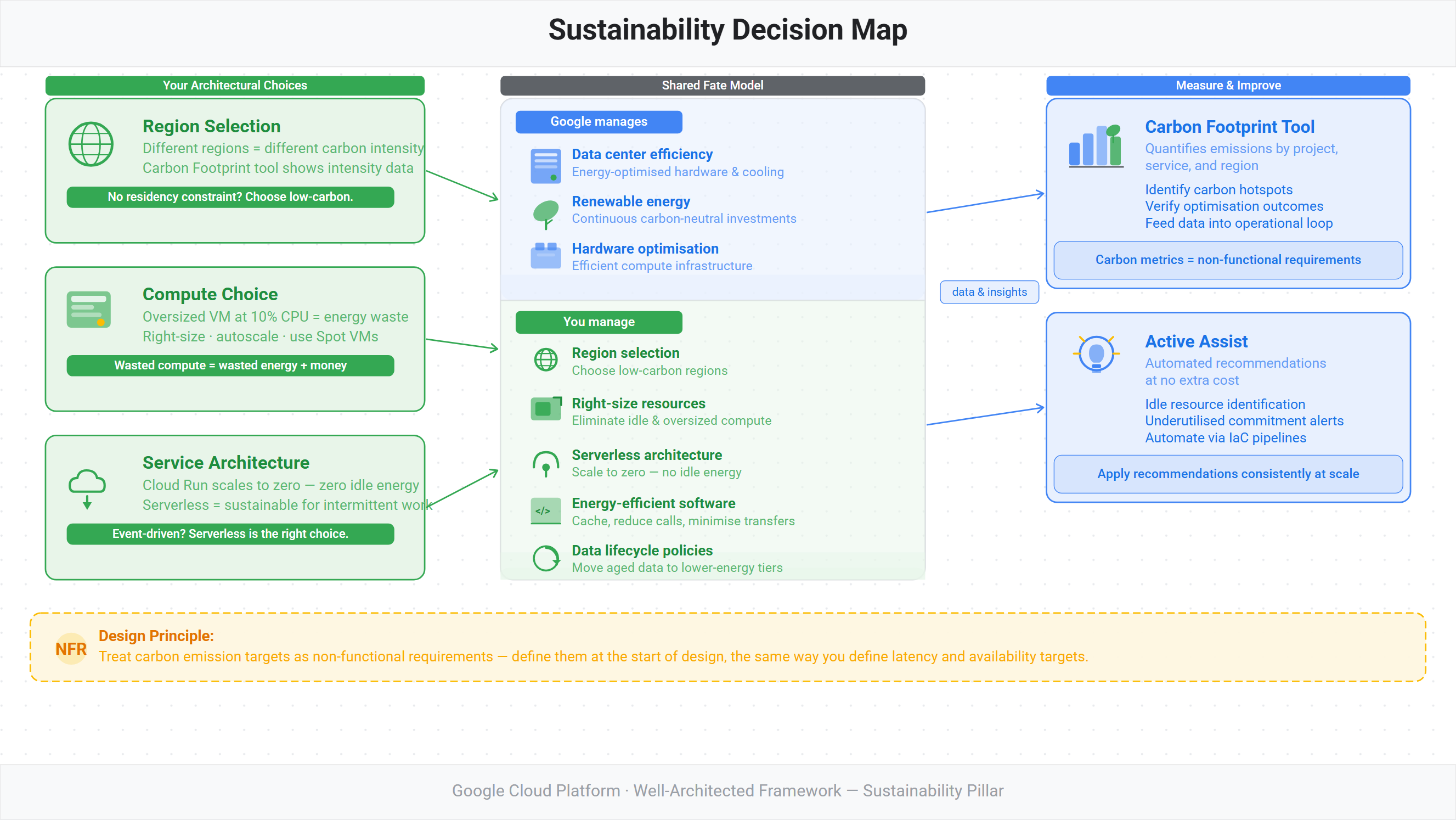
Sustainability focuses on reducing workload carbon impact through efficient architectural choices.
In practice, sustainability and efficiency often reinforce each other.
- Choose Low-carbon regions when compliance and latency constraints allow it.
- Remove Waste with right-sizing, autoscaling, and storage lifecycle policies.
- Prefer Managed and serverless services for intermittent workloads.
- Track Progress with carbon reporting data and recurring optimization cycles.
Google manages infrastructure efficiency, and your team manages workload efficiency, so both sides are required for a sustainable outcome.
Cross-Pillar Perspective
The framework also includes cross-pillar guidance for domains such as AI and machine learning.
This is relevant when designing systems with Vertex AI and generative AI workflows, where security, reliability, and cost controls all need to be addressed together.
Quick Validation Checklist
Use this checklist before finalizing an architecture:
- Confirm Operational excellence controls are automated and observable.
- Confirm Security, privacy, and compliance controls are explicit and testable.
- Confirm Reliability targets map to clear recovery objectives.
- Confirm Performance design matches expected load patterns.
- Confirm Cost controls prevent idle or overprovisioned resources.
- Confirm Sustainability choices reduce waste where practical.
If one pillar is weak, document the risk and the mitigation plan.