AI Hypercomputer
Overview
AI Hypercomputer is Google Cloud’s integrated system for demanding AI and ML workloads.
- Provides performance-optimized infrastructure for training and inference
- Combines hardware, software, and consumption models
- Helps teams move from AI prototypes to production-scale systems
Vertex AI is often the simplest managed path for AI development, while AI Hypercomputer gives you more control over the underlying infrastructure.
Why It Matters
AI workloads can become difficult to run at scale because they need large amounts of compute, fast storage, and low-latency networking.
- Training requires very large datasets and significant compute
- Serving models needs predictable performance and responsiveness
- Scaling introduces cost and operational tradeoffs
AI Hypercomputer is designed to reduce those bottlenecks with a system-level approach.
System Layers
AI Hypercomputer is built around three layers.
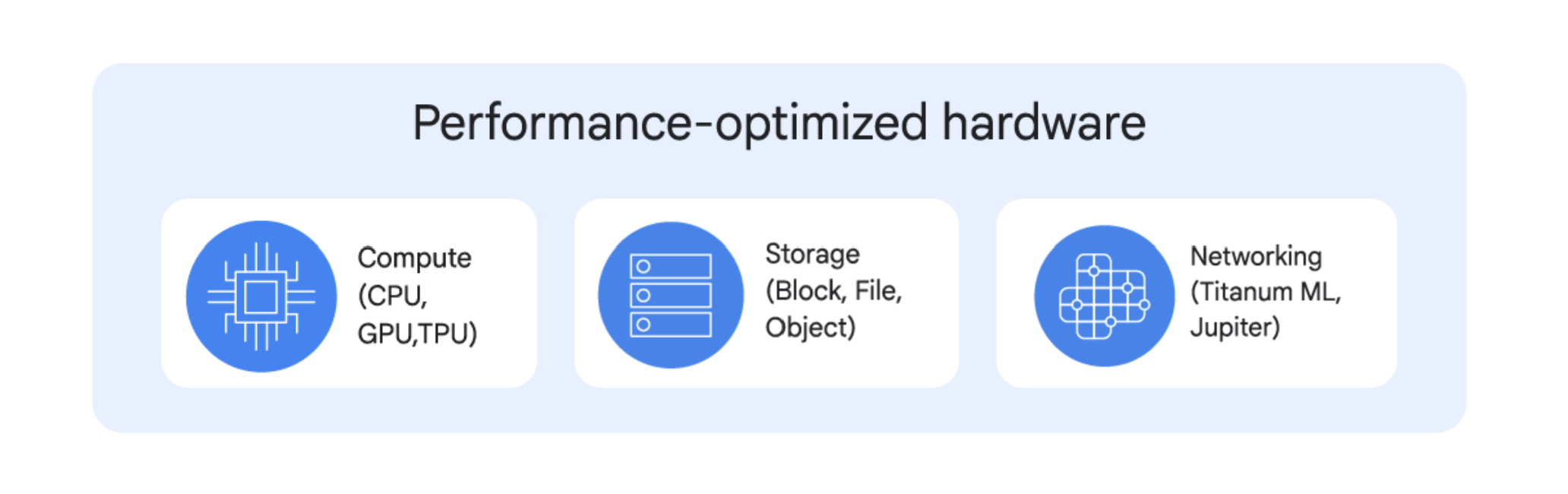
Performance-Optimized Hardware
This layer provides the raw compute and networking needed for large AI jobs.
- Google Cloud TPUs for AI acceleration
- NVIDIA GPUs for training and inference
- High-speed networking for distributed workloads
- Optimized storage for large datasets and model serving
Storage options include block, file, and object storage. Hyperdisk ML, Cloud Storage FUSE, Parallelstore, and Google Cloud Managed Lustre are examples of storage services tuned for AI and HPC use cases.
Open Software
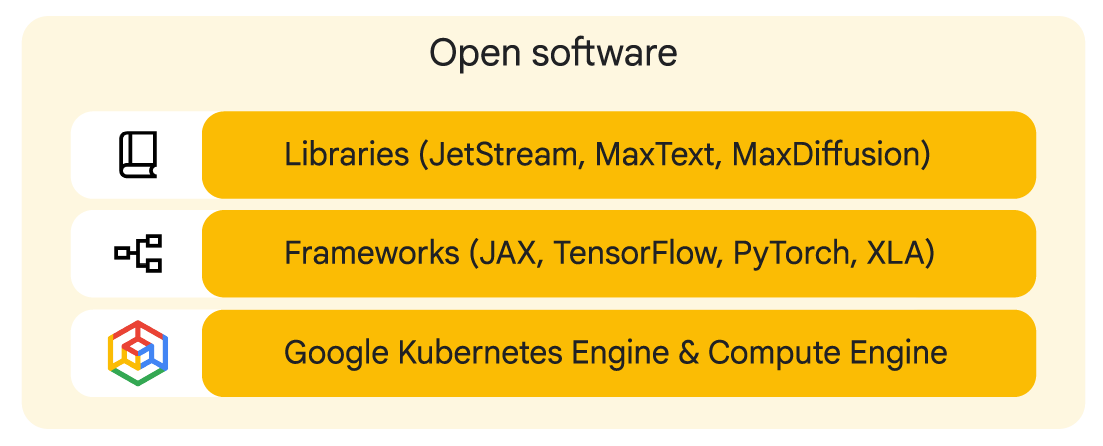
This layer provides the tools needed to build and run workloads on the hardware.
- Optimized ML frameworks such as JAX and PyTorch
- Kubernetes orchestration through GKE
- Specialized libraries and tools for distributed training and inference
The goal is to make the underlying accelerators easier to use without giving up performance.
Flexible Consumption
This layer gives teams options for paying and scaling based on workload needs.
Standard Options
On-demand gives the most flexibility, Spot gives the lowest cost, and committed use discounts help reduce spend on long-lived workloads.
- On-demand pricing for bursty or unpredictable workloads
- Spot VMs for fault-tolerant jobs with the lowest cost
- Committed use discounts for predictable steady-state workloads
Guaranteed Capacity
Guaranteed capacity is the right choice when your workload must start and run on a known set of resources.
- Reservations can be made for specific machine types and zones
- Capacity is held for critical workloads
- Reservations can be combined with committed use discounts for savings
Dynamic Workload Scheduler
Dynamic Workload Scheduler improves access to in-demand GPUs and TPUs for bursty AI workloads.
- Helps avoid long waits for scarce accelerator capacity
- Supports batch jobs through Flex Start Mode
- Integrates with GKE and Vertex AI
- Operates in Calendar Mode and Flex Start Mode
DWS is useful when you need better access to accelerators without making long-term reservations for every workload.
Future Reservations
Future reservations are useful when you need assured access to resources for a long-running or time-sensitive workload.
- Reserve capacity in advance for a specific period
- Helps with dense AI training and multi-host inference workloads
- Provides stronger confidence that the required resources will be available when needed
This option is a good fit when timing and capacity certainty matter more than maximum flexibility.
Spot
Spot is the lowest-cost option for workloads that can tolerate interruptions.
- Uses spare capacity at a deep discount
- Can be preempted when Google Cloud needs the resources elsewhere
- Works well for batch jobs, experimentation, and other fault-tolerant workloads
Spot is best when cost savings matter more than uninterrupted execution.
Key Workloads
AI Hypercomputer is useful in several common scenarios.
- Powering large-scale AI training
- Serving models efficiently at scale
- Building AI applications with open frameworks
It is designed for workloads that need strong price-to-performance, large accelerator counts, and repeatable deployments.
Powering Large-Scale AI Training
AI Hypercomputer serves as the foundational supercomputing system for AI workloads that need to scale efficiently.
- Supports training with Google Cloud TPUs and GPUs
- Helps teams work with large datasets and distributed jobs
- Provides the infrastructure needed for foundation model training and similar workloads
Serving Models Efficiently At Scale
AI Hypercomputer also supports large-scale model serving.
- Maximizes price-to-performance for inference
- Offers accelerator choices for different serving needs
- Supports high-bandwidth and low-latency serving workloads
This includes accelerator optionality such as Ironwood, Cloud TPU v5e, and G2 VM instances with NVIDIA L4 GPUs.
Building AI Applications With Open Frameworks
The platform supports open software and standards.
- Works with modern ML frameworks
- Fits open, portable deployment patterns
- Helps teams build repeatable AI applications
AI Hypercomputer directly supports open frameworks by combining hardware and software that can scale together.
Deployment Options
Google Cloud supports several ways to deploy AI workloads on this platform.
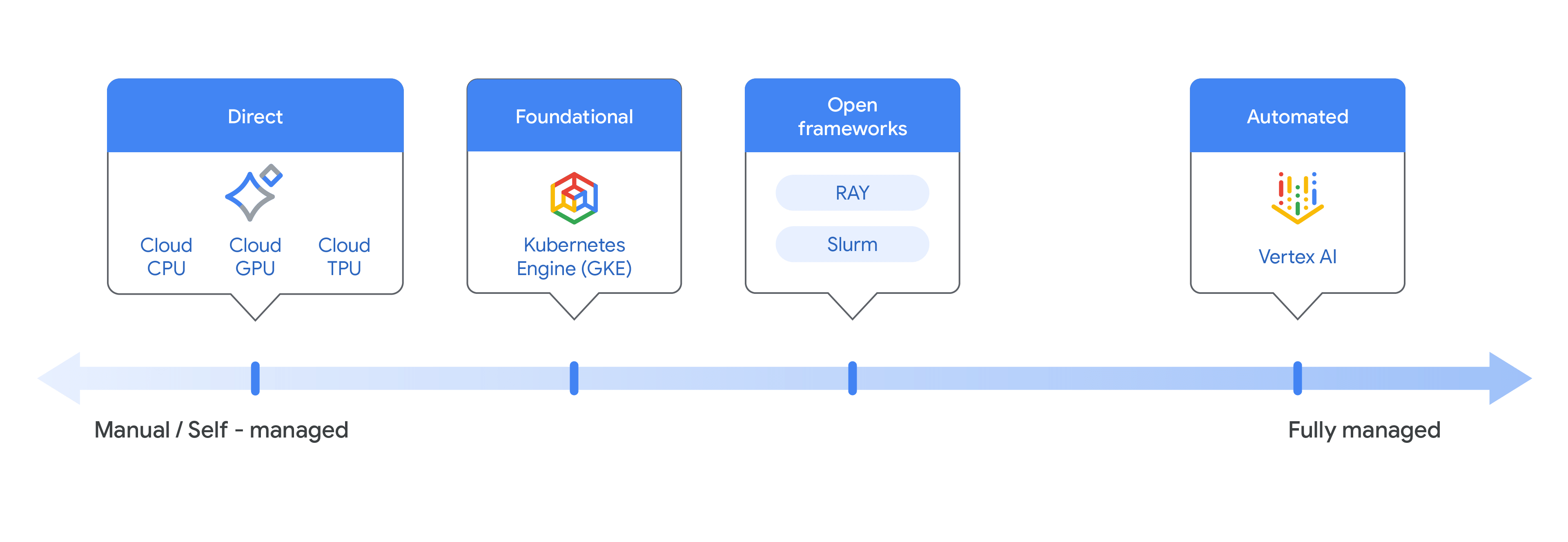
Direct Management With Compute Engine
This is the most hands-on option.
- Gives maximum control
- Uses Cloud GPU or Cloud TPU virtual machines
- Requires strong infrastructure and operations expertise
This option is best when you need fine-grained control over setup, networking, software, and scheduling.
Foundational Approach With GKE
GKE provides a more structured and cloud-native path.
- Adds orchestration for large accelerator fleets
- Supports autoscaling and job scheduling
- Balances control with automation
This is a strong choice for teams that already know Kubernetes and want portability.
Open Frameworks With Toolkits
Google Cloud also provides toolkit-based approaches for repeatable environments.
- Cluster Toolkit helps build repeatable AI and HPC environments
- Supports frameworks like Slurm and Ray
- Uses infrastructure-as-code patterns for consistent deployments
This is useful when you want standard architectures without designing everything from scratch.
Fully Managed With Vertex AI And Cloud Run
This is the easiest path for many teams.
- Vertex AI manages the broader ML lifecycle
- Cloud Run can handle event-driven inference workloads
- Google manages most of the operational complexity
This path is best when speed and simplicity matter more than low-level control.
Cloud Run For Inference
Cloud Run is a good fit for serverless AI inference.
- Scales to zero when idle
- Supports GPU-backed inference
- Works well for real-time and event-driven workloads
This makes it useful for applications that need fast responses without always-on infrastructure.
Choosing The Right Platform
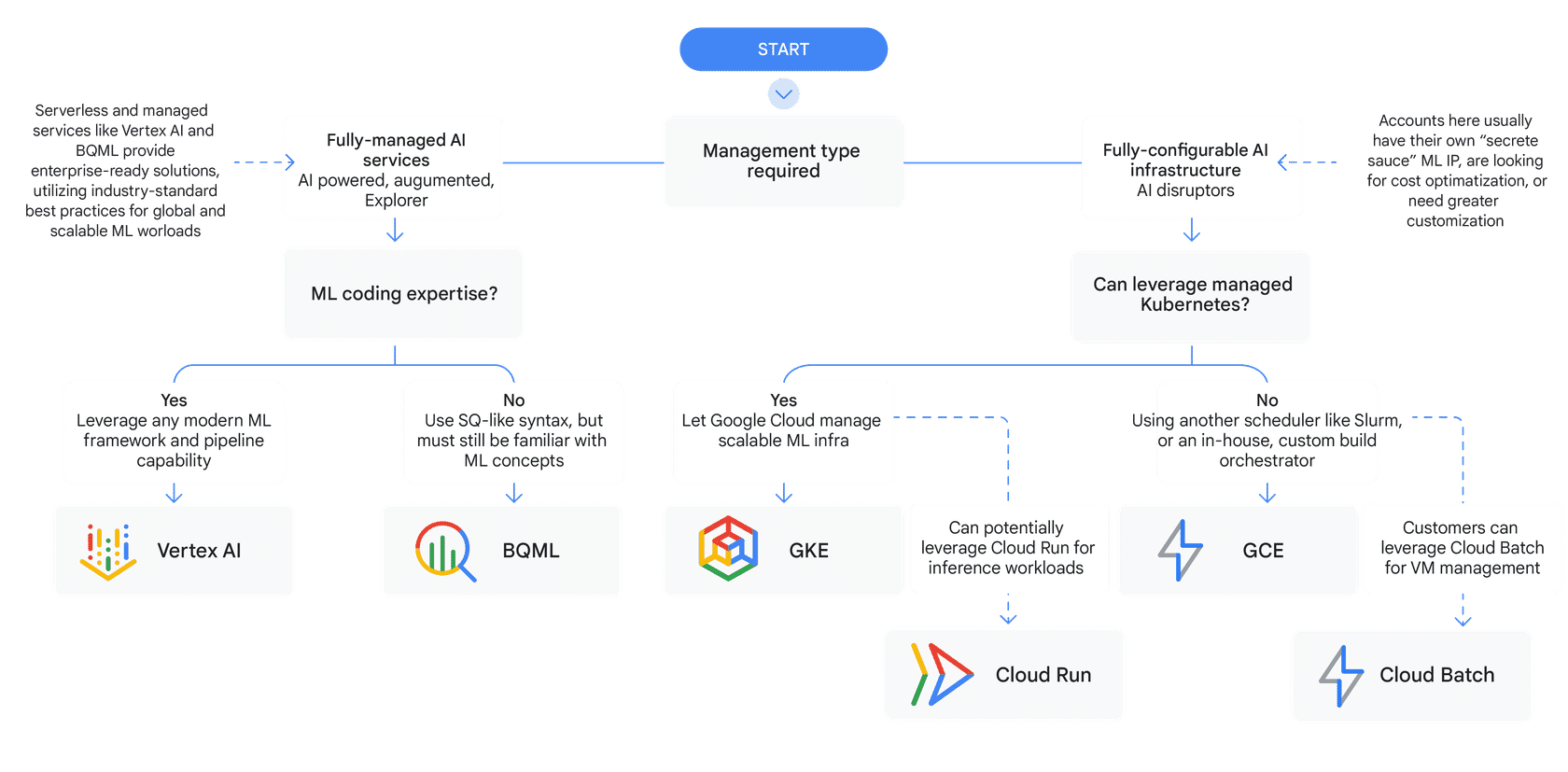
Google Cloud provides a structured decision framework for choosing the optimal ML platform based on the level of management and team expertise you need.
- Fully Managed Path
- Choose Vertex AI when you want a robust end-to-end ML platform
- Choose BQML when you prefer SQL-like syntax in BigQuery
- Fully Configurable Path
- Choose GKE when your team wants managed Kubernetes and portability
- Choose Cloud Run for serverless inference workloads
- Choose GCE when you need direct infrastructure control
- Choose Cloud Batch when VM-based batch management is the better fit
Practical rule of thumb:
- Use Vertex AI for managed ML development
- Use BQML for data teams working mostly in BigQuery
- Use GKE or GCE when you need more infrastructure control
- Use Cloud Run when the workload is event-driven and serverless fits best
The decision tree is about platform fit, not model quality. It helps you choose the operational layer that matches your team and workload.
Note: AI Hypercomputer is not a replacement for AI models or ML frameworks. It is the infrastructure and orchestration layer that helps those workloads scale reliably.
| Need | Better Fit |
|---|---|
| Quick start and managed workflows | Vertex AI |
| More infrastructure control | AI Hypercomputer with GCE or GKE |
| Kubernetes-based orchestration | AI Hypercomputer with GKE |
| Serverless inference | Cloud Run |
| Repeatable HPC and AI blueprints | Cluster Toolkit and open frameworks |