Network Management with SNMP and NTP
Overview
Network management depends on visibility and consistent time. SNMP helps monitor and manage devices, and NTP keeps clocks synchronized so logs, alerts, and service-level measurements can be trusted.
SNMP
Simple Network Management Protocol (SNMP) lets a management system collect information from routers, switches, servers, and security appliances.
For more information, please see SNMP page.
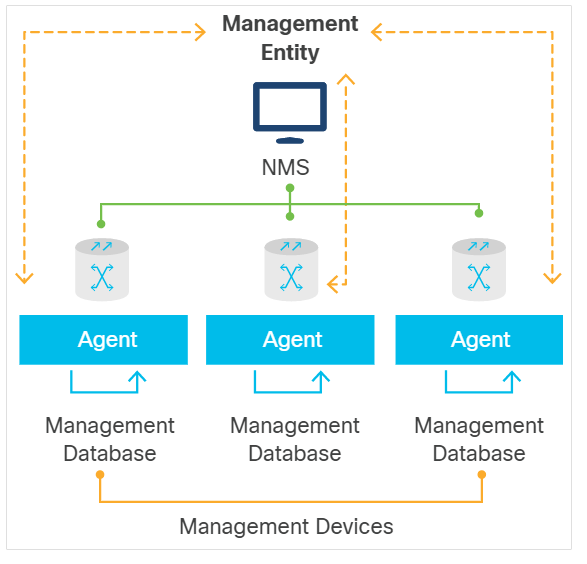
SNMP has three core elements:
| Element | Purpose |
|---|---|
| SNMP manager | The network management system that sends requests and receives alerts. |
| SNMP agent | Software on the managed device that exposes management data. |
| MIB | A structured database of object identifiers and values. |
SNMP Operations
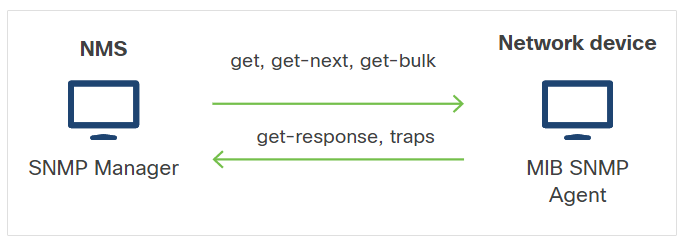
SNMP managers and agents exchange a small set of message types:
| Message | Purpose |
|---|---|
Get | Reads a specific variable from the agent. |
GetNext | Reads the next variable in the MIB tree. |
GetResponse | Returns data or an error for a manager request. |
Set | Changes a variable or triggers an action. |
Trap | Sends an unsolicited event notification to manager. |
SNMP Security
SNMPv1 and SNMPv2c use community strings, which behave like plaintext passwords. SNMPv3 adds authentication, encryption, and message integrity.
Use these practices:
- Disable SNMP when it is not needed.
- Replace default communities such as
publicandprivate. - Prefer SNMPv3 for sensitive environments.
- Restrict SNMP access to approved management hosts.
- Use read-only access unless configuration changes are required.
NTP
Network Time Protocol (NTP) synchronizes clocks across network devices and systems. Consistent time is important for troubleshooting, log correlation, monitoring, billing, and service-level agreements.
NTP uses UDP port 123.
NTP Strata
NTP uses strata to describe distance from an authoritative time source.
| Stratum | Description |
|---|---|
| 1 | Directly connected to a highly accurate time source. |
| 2 | Synchronizes from a stratum 1 server. |
| 3+ | Synchronizes farther away from the original source. |
NTP clients usually prefer lower-stratum sources, but they also compare multiple sources and avoid time sources that appear incorrect.
NTP Association Modes
| Mode | Description |
|---|---|
| Client/server | A client requests time from one or more servers. |
| Symmetric active/passive | Peer time servers back each other up. |
| Broadcast or multicast | Servers announce time on a local network with less setup. |
NTP Security
Protect time sources because incorrect time can break logs, certificates, monitoring, and incident response.
- Allow NTP traffic only from trusted sources.
- Use authentication where supported.
- Configure more than one trusted time source.
- Monitor for clock drift or unsynchronized devices.