GPU Framework Acceleration
Overview
GPU performance depends on both hardware and software.
- Frameworks decide how model code maps to accelerator operations.
- Compilers and kernels decide how efficiently those operations run.
- Portability layers help the same model move across GPU, TPU, and CPU targets.
This page focuses on the framework and compiler layers that help GPU workloads run efficiently.
Why Framework Acceleration Matters
Modern AI workloads depend on more than raw accelerator availability.
- Throughput depends on kernel efficiency.
- Latency depends on execution overhead and memory movement.
- Multi-device portability depends on software abstractions and compiler backends.
Frameworks such as TensorFlow, PyTorch, and JAX reduce the need to write low-level GPU code directly, while still taking advantage of device-specific acceleration.
CUDA Kernels
CUDA is NVIDIA's parallel computing platform and programming model.
- The lowest-level programming interface commonly used by higher-level ML frameworks on NVIDIA GPUs.
- Framework operations (e.g. matrix multiplication, convolution) are dispatched to optimized CUDA kernels.
- Those kernels are designed to exploit the GPU memory hierarchy and Tensor Core capabilities.
How CUDA helps GPU execution:
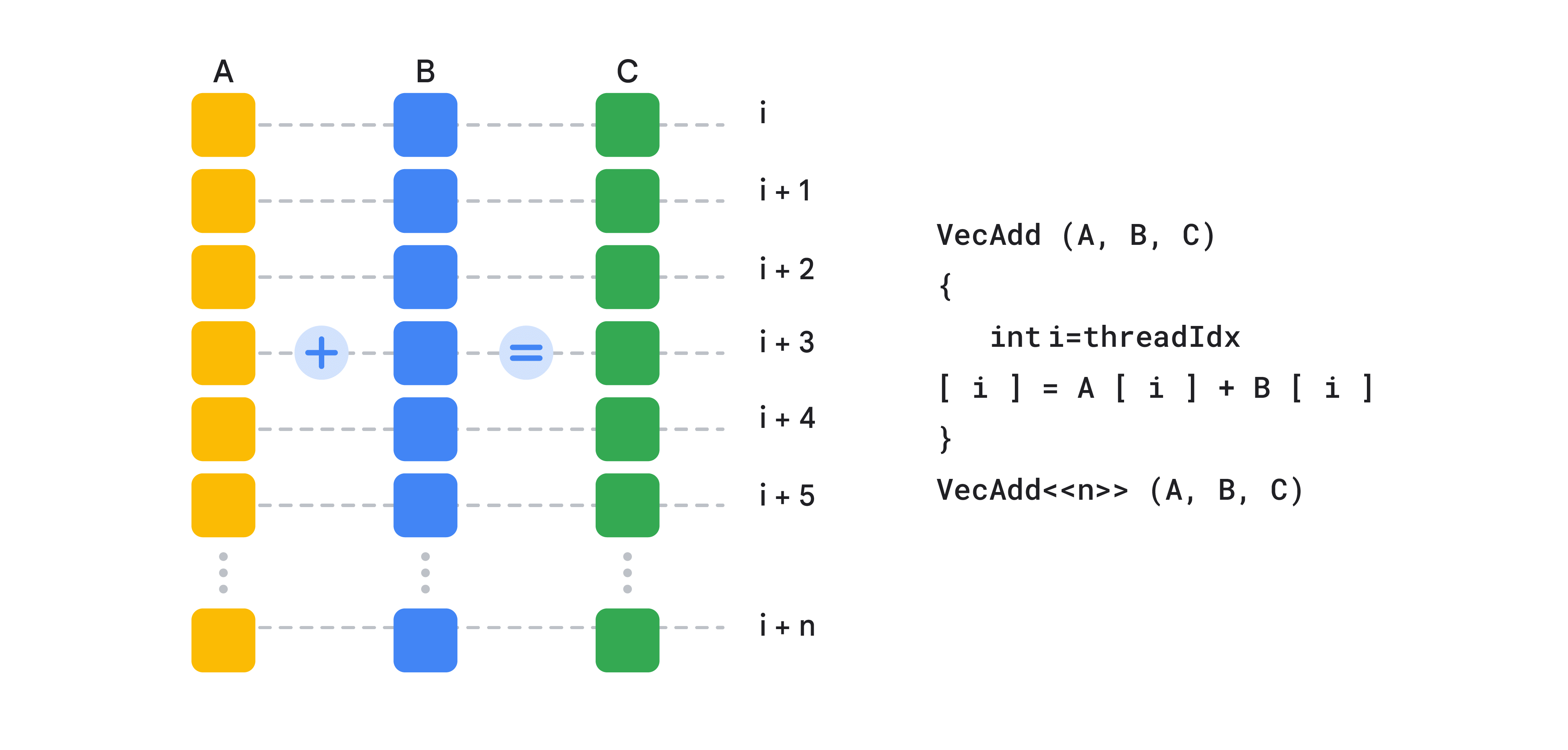
- Uses highly optimized kernels for common deep learning operations.
- Improves parallel execution across many GPU threads.
- Helps align memory access patterns for better bandwidth utilization.
This is why GPU execution can far exceed CPU throughput for highly parallel AI workloads.
While CPUs usually handle a small number of threads efficiently, GPUs are designed for far higher parallelism, and CUDA is the key software interface that exposes that capability.
XLA Compilers
XLA, or Accelerated Linear Algebra, is a domain-specific compiler that optimizes computation graphs before execution.
- Instead of running each operation eagerly and independently, XLA captures a graph of operations.
- It then optimizes the whole graph before compiling it for the target accelerator.
- This model improves efficiency across GPUs, TPUs, and CPUs.
Important XLA optimization patterns include:
| Optimization | Description |
|---|---|
| Operator fusion | Combines multiple operations into fewer kernels. |
| Memory optimization | Reduces unnecessary memory allocations and data transfers. |
| Layout optimization | Arranges data to better match device access patterns. |
These optimizations can reduce overhead and improve real-world throughput for large AI workloads.
PyTorch/XLA And JAX/XLA
PyTorch/XLA and JAX/XLA connect familiar framework workflows to the XLA compiler stack.
PyTorch/XLA
PyTorch/XLA extends standard PyTorch so model graphs can be compiled and executed through XLA.
- Model code remains close to standard PyTorch.
- The integration converts the graph into XLA's intermediate representation.
Features that can help large model training include:
- Gradient checkpointing
- Distributed execution support
This makes PyTorch/XLA useful when you want PyTorch ergonomics with deeper compiler-driven acceleration.
JAX/XLA
JAX is designed with XLA as a core backend.
- Its tracing model is well-suited for graph capture and optimization.
- Its functional style maps cleanly to XLA compilation.
- Works well for workloads that benefit from aggressive graph-level optimization.
This makes JAX a strong fit when compiler-driven performance and portability are both important.
Performance Across Diverse Hardware
GPUs, TPUs, and CPUs have different architectures and execution models, which makes it difficult to write code that is both portable and efficient across all hardware.
ML frameworks and the XLA compiler reduce this complexity by generating optimized code for the target device. This allows the same codebase to run efficiently on different accelerators with minimal changes.
When targeting high-performance hardware, the goal is to:
- Minimize idle compute cycles.
- Maximize computational throughput.
- Optimize memory access and data movement.
This approach is especially useful when:
- Training moves from one accelerator type to another.
- Hardware availability or capacity changes.
- The same workloads need to run across GPU, TPU, and CPU environments.
Framework Abstraction
Machine learning frameworks such as PyTorch and JAX provide a layer of hardware abstraction.
Instead of writing hardware-specific code, you define your model using high-level APIs for tensors, operations, and neural networks. The framework handles the device-specific implementation.
- Write model code once and run it across GPUs, TPUs, and CPUs.
- Minimize hardware-specific code changes.
- Let the framework translate high-level operations into device-specific instructions.
XLA As A Cross-Platform Optimizer
XLA itself is hardware-agnostic at the graph level.
- It accepts the same high-level computation graph.
- It selects a backend based on the target device.
- Each backend applies optimized code generation for that hardware class.
This means one graph can be compiled for an NVIDIA GPU, a Google Cloud TPU, or a CPU, with device-aware optimization at the backend layer.
Cross-Platform Framework Integrations
PyTorch/XLA and JAX/XLA are the practical bridges that make cross-device execution more realistic.
- They reduce the engineering overhead of per-device tuning.
- They let teams stay in a familiar programming model.
- They help scale models while preserving a relatively consistent developer workflow.
For example, PyTorch/XLA can help teams move toward TPU or GPU targets while keeping much of the same model definition flow.
Practical Tradeoffs
Framework portability improves flexibility, but it does not remove all hardware-specific tradeoffs.
| Area | Practical Impact |
|---|---|
| CUDA specialization | Delivers strong NVIDIA GPU performance, but ties optimization more closely to that hardware stack. |
| XLA graph optimization | Improves execution efficiency by optimizing whole computation graphs before launch. |
| Framework portability | Helps reuse model code across GPUs, TPUs, and CPUs with fewer changes. |
| Peak tuning effort | Maximum performance can still require hardware-specific tuning and testing. |
Note: Cross-platform portability is useful, but the highest performance often still comes from tuning for the dominant target accelerator.